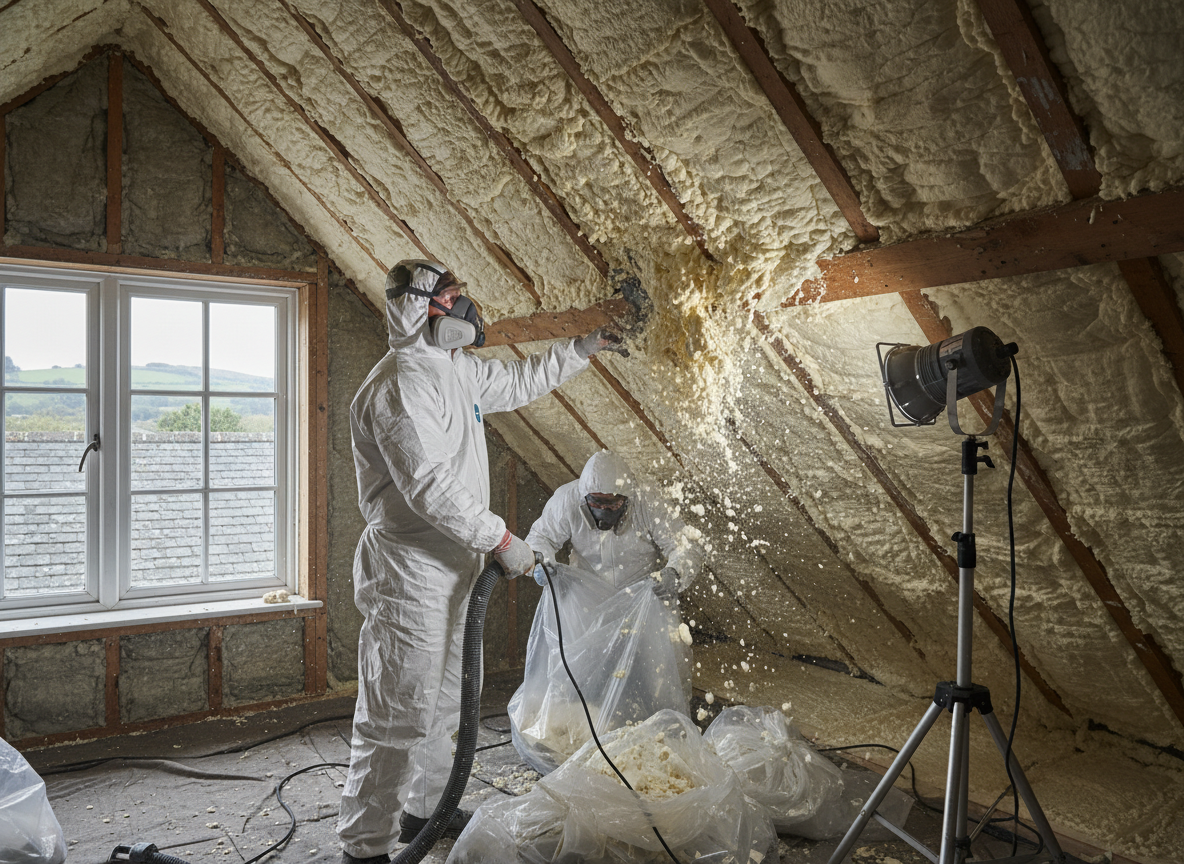
Barnstaple’s older terraced and semi-detached homes, especially those built before the 1960s in areas such as Pilton, Newport and Roundswell, frequently have spray foam applied directly to original lath and plaster or slate roofs. Once moisture from the region’s persistent Atlantic rain penetrates the foam it becomes trapped against timbers, accelerating rot in rafters and ceiling joists that are already vulnerable in these properties.
Removal requires careful mechanical stripping followed by thorough inspection of the roof void. In many Barnstaple lofts the foam has been sprayed over electrical cables and pipework, so each section must be cut back in stages to avoid damaging live wiring or lead water pipes common in pre-war housing stock. Dust and debris are extracted using sealed vacuums to prevent contamination of the rooms below.
After the foam is cleared, ventilation is restored by fitting eaves vents and ridge ventilation where original airflow paths were blocked. This step is essential in Devon’s damp climate to stop condensation returning to the now-exposed roof structure. Homeowners in the EX31 postcode often notice improved loft temperatures within weeks once the insulation is removed and proper airflow returns.
Edge cases include foam that has been applied over asbestos-containing insulation board in 1950s council houses around Forches and Whiddon Valley. These require separate containment procedures before any foam work begins.
Technician insight
In Barnstaple the thing that catches most people out with loft spray foam removal is how quickly rain soaks through the foam in older slate roofs around Pilton and Newport, turning the material into a sponge that hides rot until we strip it back.
Blocked Ventilation in a Newport Terrace
Homeowner noticed musty smells and peeling ceiling plaster in a 1930s terrace. We found spray foam had sealed the eaves completely, trapping moisture against the rafters. After staged removal and fitting new eaves vents the loft dried out and the ceiling repairs held without recurring damp.
How it works
- 1
Site Survey and Risk Assessment
We attend the property in Barnstaple to examine foam depth, roof condition and access points, noting any electrical or plumbing runs hidden beneath the material.
- 2
Controlled Foam Removal
Foam is cut and peeled in sections using hand tools and HEPA-filtered extraction to limit dust spread through the house.
- 3
Timber Inspection and Cleaning
Rafters and joists are checked for rot or staining; loose debris is removed and surfaces are brushed clean before ventilation upgrades.
- 4
Ventilation Restoration
Eaves and ridge vents are fitted where needed to restore airflow in line with typical Devon roof construction.
Pricing
Cost depends on loft size, foam thickness and access difficulty in Barnstaple properties.