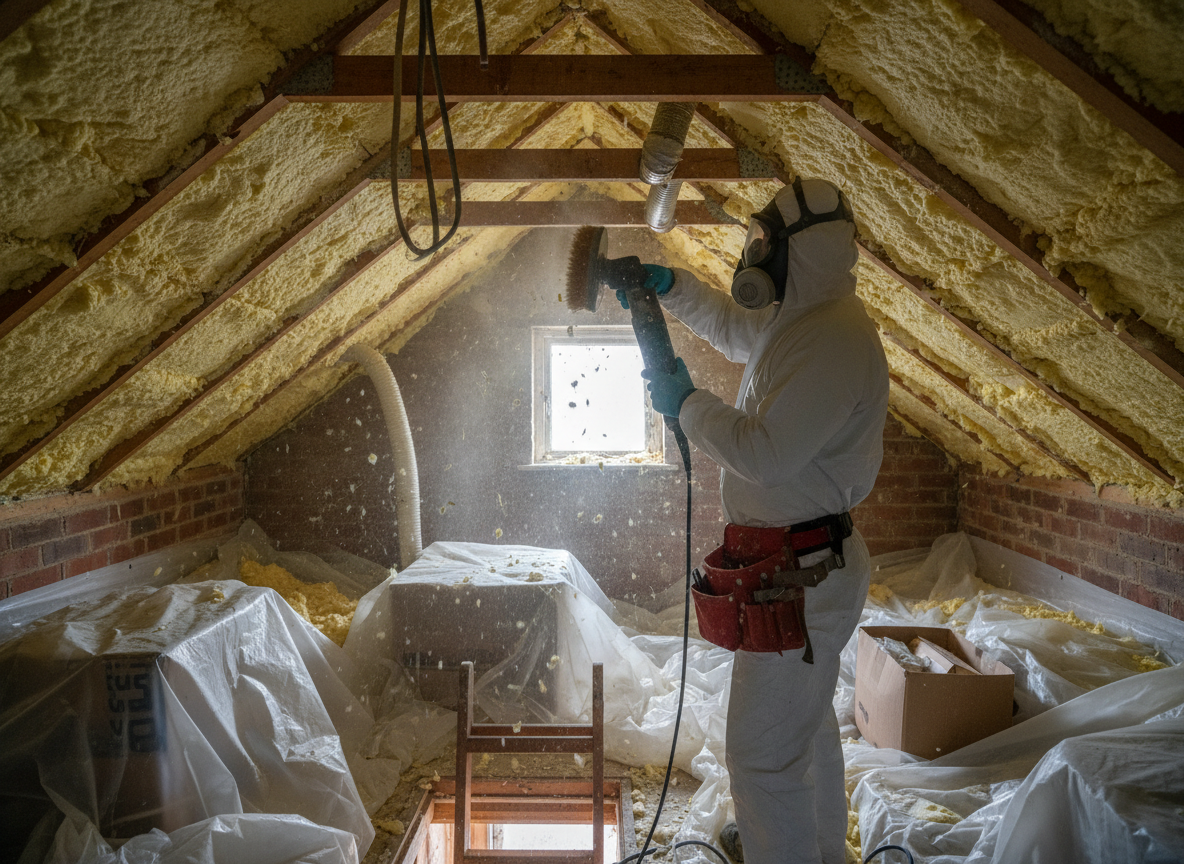
Barnstaple homes built before the 1980s often have spray foam applied directly to rafters and stone walls in lofts, trapping moisture against the original fabric. Once winter temperatures drop and rain drives in from the Atlantic, this leads to rot in timber joists and black mould on ceilings below. Removal requires cutting back the foam in sections without damaging lathe and plaster or exposing wiring runs that were never intended to be covered.
The tight roof voids common in terraced houses near the town centre and in Pilton mean every piece of foam must be bagged on site to stop dust settling through floorboards into living spaces. We use negative-pressure extraction fans vented through existing loft hatches and always check for asbestos in older artex ceilings before starting any mechanical removal.
After the foam is gone, the rafters need time to dry before any new insulation goes back in. In properties around Ladywell and along the Taw estuary, we leave the space open for at least a week and return to test moisture levels so owners avoid repeating the same damp problem with replacement materials.
Disposal of the removed foam follows Environment Agency rules for construction waste; we separate the polyisocyanurate from any contaminated timber and take everything to the licensed site in Barnstaple rather than leaving skips on narrow residential streets.
Technician insight
In Barnstaple, the thing that catches most people out with Residential Spray Foam Removal is how many pre-war stone terraces around Ladywell still have the original lathe ceilings directly under the foam; one careless scrape and you drop plaster dust into every room below.
Pilton Terrace Loft Clearance
Homeowners in a 1930s terrace near Pilton noticed black mould on bedroom ceilings after heavy autumn rain. We found closed-cell foam bonded straight to the rafters and trapping moisture against the stone gable. The foam was cut out in sections under negative pressure, waste removed to the Barnstaple facility, and the void left open to dry for ten days before any new insulation was installed.
How it works
- 1
Initial Loft Inspection
We access the roof void through the existing hatch and photograph every area of foam, checking for hidden wiring, pipework and signs of damp in the rafters.
- 2
Containment Setup
Dust sheets and negative-pressure fans are fitted to isolate the work area so particles do not drift into bedrooms or kitchens below.
- 3
Sectional Foam Removal
Foam is cut back in manageable strips using handheld tools, bagged immediately and carried out through the loft hatch to avoid dragging debris through the house.
- 4
Rafter Drying and Final Check
After removal we leave the void ventilated for several days, then return to measure moisture content before any new insulation is considered.
Pricing
Price depends on loft size, foam thickness and access difficulty; we provide a clear written quote after the inspection.